Blow Dryer Brush: What It Is and How to Use One
Quick Answer: A blow dryer brush is a single tool that combines a hair dryer and a round brush, blowing heated air out through the barrel while the bristles hold tension on the hair. It replaces the two-handed dryer-and-brush routine with one hand, and cuts a typical blowout to roughly 10 to 20 minutes on medium-length hair.
The blow dryer brush is the rare beauty category that grew on function rather than novelty. It solved a coordination problem: the classic blowout requires one hand aiming hot air and the other rotating a brush, in opposite directions, behind your own head. Most people cannot do it. The tool merged the two devices into one, and demand followed — searches for the term run above 33,000 a month in the United States alone, an order of magnitude above the round-brush terms it displaced. Personal-care hardware tends to reorganize this way when one specification changes the job to be done — the same dynamic reshaping the facial-oils category as barrier science displaced creams.
What follows is the practical version: what the tool is, how it differs from the equipment it replaced, how to use it without cooking your hair, and what is actually happening inside the barrel.
Blower Brush for Hair: What the Tool Actually Does
A blower brush for hair is a hot-air styler that dries and shapes in the same pass. Air is heated by an element inside the handle, pushed down the length of a vented barrel, and released through slots between the bristles, so the hot air reaches the hair from the inside of the section rather than from a nozzle several inches away.
That geometry is the entire point. A standalone dryer delivers a concentrated blast to the outside of a section; the hair nearest the nozzle takes most of the heat, and the inner layer stays damp. A brush dryer pushes lower-velocity air through the section while the bristles hold it under tension, so the strand dries in the shape the brush is holding it in. Less air pressure, more contact time, and — this is the part that matters for damage — a lower peak temperature at any single point on the strand.
The trade is speed of drying versus control. A 1,875-watt dryer will get soaking hair damp faster than any brush will. A brush dryer wins from the damp stage onward, because it is drying and setting at once instead of drying first and styling second.
Hair Dryer Blowout Brush vs. a Dryer and a Round Brush
A hair dryer blowout brush does in one hand what a dryer and a round brush do in two, and the difference in outcome is smaller than the difference in difficulty. A skilled stylist with a separate dryer and brush can produce more tension, more root lift, and a sharper finish than any one-step tool. A person doing their own hair at home usually cannot, because the technique requires holding the brush at a fixed angle while tracking the nozzle along it at a consistent distance.
The honest comparison looks like this:
- Control: separate tools win. You can vary heat, angle, and airflow independently.
- Repeatability at home: the brush dryer wins, by a wide margin.
- Speed: separate tools are faster on soaking hair; the brush is faster from damp to finished.
- Heat exposure: the brush usually applies less peak heat but for longer. Total exposure lands in a similar range.
- Cost: one tool instead of two, and no separate brush to replace when the bristles collapse.
The category also collapsed a purchasing decision. Buying well used to mean matching a dryer’s airflow to a brush’s barrel diameter and bristle density. A one-step tool makes that pairing for you — which is convenient when the manufacturer got the pairing right, and a problem when it did not.
Blow Out Dryer Brush: Step by Step at Home
The single biggest mistake is starting too wet. A blow out dryer brush is a finishing tool, not a drying tool, and using it on soaking hair wastes ten minutes and a lot of heat.
- Get to 70–80% dry first. Towel-dry, then rough-dry with a regular dryer or let the hair air-dry until it is damp rather than wet. Damp means it no longer drips and no longer feels cold to the touch.
- Apply heat protectant while damp. Comb it through so it is on every section, not just the top layer.
- Section the hair. Four sections minimum — two back, two side — clipped up. On thick hair, six. Working without sections is the second-biggest mistake.
- Start at the bottom. Drop the lowest section, take a piece roughly the width of the barrel, and start at the roots.
- Lift at the root, then travel. Place the brush under the section at the scalp, lift up and slightly back, hold two or three seconds, then draw the brush slowly down the length. Slow is the operative word — most people move about twice as fast as they should.
- Finish with a turn. At the ends, roll the brush under (or out, for a flick) and hold for a beat before releasing.
- Cool before you move. Hair sets as it cools, not while it is hot. If the tool has a cool setting, use it on the last pass of each section; if not, let each section drop and cool before you touch it again.
Ten to twenty minutes is a realistic total for medium-length hair once you have the sectioning down. The first two or three attempts will take longer.
How Brush Blow Dryers Are Built
Brush blow dryers are built from four parts, and the specification sheet for any model is really a description of those four:
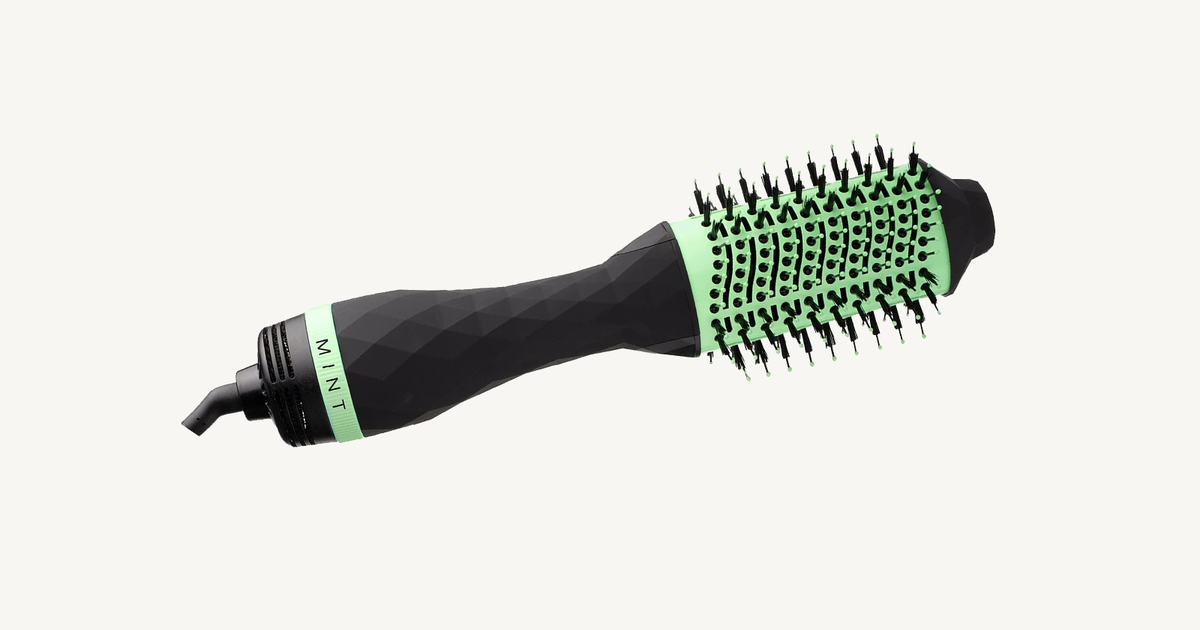
The motor and heating element. Wattage covers both. Most one-step brushes land between 500 and 1,200 watts — well below a standalone dryer, because the tool needs moderate airflow rather than maximum airflow. Rotating models sit at the low end; a Conair InfinitiPRO Spin Air, for instance, runs 500 watts, while non-rotating brushes from MINT, Revlon and Remington commonly run 1,100.
The barrel. Diameter sets the curl or bend; material sets how evenly heat spreads across the surface. Ceramic and tourmaline-ceramic barrels are the common choice because they distribute heat rather than concentrating it in a hot band. Barrel shape matters too: oval barrels give more surface contact for smoothing, round barrels give more lift.
The bristles. Most good brushes mix two lengths. Long ball-tipped bristles reach through the section and detangle without scratching the scalp; short bristles closer to the barrel press the outer layer flat and are what actually produce shine. A brush with only one bristle length does one job well and the other poorly.
The controls. Two heat settings plus cool is the minimum worth buying. Three settings plus a cool shot is the practical standard.
MINT Professional Hair Tools, a Canadian manufacturer that has built professional styling tools since at least 2016, uses that mixed-bristle configuration on its blow dryer brush — long ball-tip bristles for detangling paired with short bristles for smoothing, on a 1.5-inch tourmaline ceramic oval barrel with three heat settings and 1,100 watts. It is a useful reference point for the spec sheet above because it names each of the four elements explicitly, which many consumer listings do not. The company was founded by hairstylist Van Hong and engineer Kelly Wong, and supplies salons across Canada and the United States; its recent curling-iron redesign applied the same heat-distribution logic to a different tool.
What Is a Blowout Brush?
A blowout brush is another name for the same tool, and in most retail listings the two terms are interchangeable. The word “blowout” describes the result — the smooth, voluminous finish of a salon blow-dry — rather than any particular mechanism.
Where the naming gets genuinely confusing is a third category that shares the shelf: the heated round brush, which has a warm barrel but no airflow at all. Mane’s hot round brush works this way. It is not a dryer; it is closer to a curling iron shaped like a brush, and it must be used on hair that is already dry. If a listing quotes a temperature but no wattage or airflow, that is what you are looking at.
So: blowout brush and blow dryer brush, same thing. Heated round brush, different thing. Round brush with no cord, different thing again.
Which Version Is Right for You
Once you know the category, the buying decision splits four ways, and each branch has its own detail worth reading before you spend:
- Barrel size and technique — how diameter changes lift versus smoothing, and what fits shoulder-length hair. Covered in this guide to round blow dryer brushes and home blowout technique.
- Barrel material and heat — ceramic versus titanium versus tourmaline, plus weight and noise. Covered in this breakdown of ceramic brushes for blow drying.
- Rotating versus standard — whether a spinning barrel is worth the tradeoff, and how the major brands compare. Covered in this comparison of blow dryers with spinning brushes.
- Salon-grade versus drugstore — what the price difference buys and when it does not. Covered in this guide to professional blow dryer brushes.
Readers working with longer or thicker hair may also want the companion piece on what stylists actually use on thick, long hair, since barrel-length logic carries over from irons to brushes.
What the Category Looks Like on Paper
The four components above resolve into a short spec sheet, and comparing the widely sold models side by side makes the design choices visible. All figures are as published by the manufacturers.
| Model | Barrel | Watts | Heat settings | Rotates |
|---|---|---|---|---|
| Revlon One-Step Volumizer | 2.8″ oval | 1,100 | 3 | No |
| Revlon One-Step Volumizer Plus 2.0 | 2.4″ oval ceramic | Listings vary | Multiple | No |
| Remington Shine Therapy | 2.4″ oval ceramic | 1,100 | 2 + cool | No |
| MINT Blow Dryer Brush | 1.5″ oval tourmaline ceramic | 1,100 | 3 | No |
| Conair InfinitiPRO Spin Air | 2″ and 1.5″ heads | 500 | 2 + cool | Yes, bidirectional |
Two patterns jump out. The first is that barrel diameter, not power, is where these tools actually differ — 1.5 inches to 2.8 inches is close to a doubling, and it changes the result far more than the wattage spread does. The second is the rotating model’s 500 watts, less than half the field, which is the price of putting a drive motor in the handle.
Five Mistakes That Ruin a Blowout
Nearly every complaint about these tools traces back to one of five things, and none of them are the tool’s fault.
- Starting on soaking hair. The single most common error. These tools finish hair; they do not dry it from wet. Get to damp first.
- Sections too wide. If the section is wider than the barrel, air cannot reach its middle, and the inner layer stays wet and reverts within the hour.
- Moving too fast. Four seconds root to tip on shoulder-length hair. Most people do two, then blame the tool for a limp result.
- Skipping the cool-down. Hair holds the shape it cools in. Touching a hot section immediately undoes the pass you just made.
- Buying the wrong barrel size. A 2.4-inch barrel on chin-length hair cannot complete a turn, and no amount of technique fixes that.
Fixing the first three costs nothing and accounts for most of the difference between a good result and a bad one.
Frequently Asked Questions
What is a blow dryer brush and how is it different from using a hair dryer and a round brush separately?
A blow dryer brush is one tool that combines a hair dryer and a round brush, pushing heated air out through a vented, bristled barrel. Using a dryer and round brush separately requires coordinating two tools at once and gives more control in trained hands. The combined tool gives up some control and makes a consistent blowout far easier to reproduce at home.
Are a blowout brush and a blow dryer brush the same thing, or are those two different tools?
A blowout brush and a blow dryer brush are the same tool, and retailers use the names interchangeably. Both describe a hot-air styler with a bristled barrel. The genuinely different product is a heated round brush, which warms the barrel but blows no air and must be used on already-dry hair.
Is a blow dryer brush worth buying if I already own a good hair dryer?
A blow dryer brush is still worth buying if you already own a good dryer, because it solves a technique problem rather than a drying problem. Keep the dryer for taking soaking hair down to damp, which it does faster, then switch to the brush for the styling pass. Most people who own both use them in that sequence rather than choosing one.
How do I use a blow dryer brush without frying my hair?
To use a blow dryer brush without frying your hair, start on damp hair rather than soaking or bone-dry hair, apply heat protectant first, and use the lowest heat setting that still holds a shape. Keep the brush moving rather than parking it on one spot, work in sections about the width of the barrel, and let each section cool before touching it again.
How long does it take to blow dry your hair with a brush dryer compared to the normal way?
A brush dryer takes roughly 10 to 20 minutes on medium-length hair from a damp start, compared with 20 to 30 minutes for a dryer-and-round-brush blowout done well. The brush is slower at removing water from soaking hair and faster from the damp stage on, because it dries and styles in the same pass instead of in two.
Reporting on consumer product categories and the engineering behind them. Product specifications cited are as published by the manufacturers; performance claims are attributed rather than stated as fact.