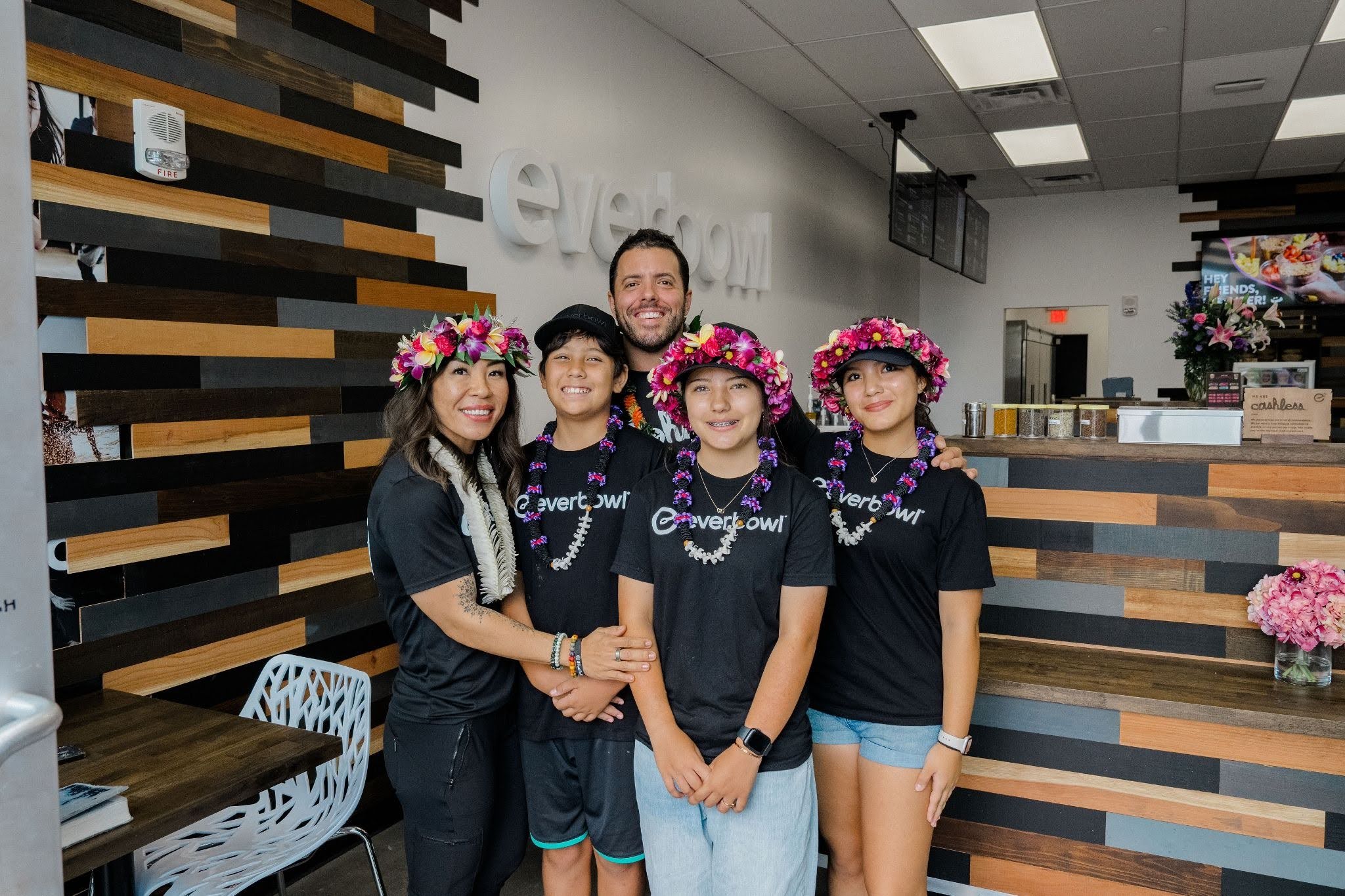
Most franchise operators who open a second location do so in their second or third year of operations. Brandon and Angela Padilla did it before their first anniversary.
On May 1, 2026, the couple opened their second everbowl location in Pearl City, Hawaii — less than twelve months after launching their inaugural O’ahu store. For senior operators and investors watching franchise performance data, that timeline warrants a closer look. The variables that enabled it are specific, transferable, and worth mapping.
everbowl, founded in 2016 by entrepreneur Jeff Fenster in San Diego, is an elevated fast-casual destination with over 100 locations nationwide. Its menu is built on fully customizable superfood-based açaí bowls, smoothies, toasts, and other better-for-you options. The brand’s five core values — Make Friends, Have Fun, Kaizen, Be Remarkable, and Have Integrity — are operational standards, not branding assets. The franchisees who align with them before signing tend to perform differently than those who discover them after.
The Padillas are the former category. And their Pearl City expansion is a clean case study in what that difference produces.
The Pre-Investment Conviction Advantage
One of the most persistent variables in franchise performance data that operators undervalue at the selection stage is pre-investment belief. Franchisees who enter a system because they already believed in the product — who were customers before they were operators — carry a fundamentally different operating posture than those who entered through financial modeling alone.
The Padillas have been fans of the everbowl brand for years. They were familiar with the product, the brand culture, and the operational philosophy from the consumer side. When they signed, their conviction had already been tested across multiple purchase decisions.
That starting point changes the unit economics of the learning curve. The typical franchise operator invests their first six to eight months building the belief in the product that the Padillas brought in from day one. That compressed timeline redirects attention toward operational execution, team development, and community integration — the variables that actually drive repeat visit rates and sustained revenue.
“As parents with busy schedules, we know how hard it can be to find food that’s quick, delicious, and consistent,” said Brandon Padilla. “That’s what drew us to everbowl. We’ve been fans of the brand for years, and we believe in what makes it different.”
For senior executives evaluating franchise systems or advising operators, this is a selection-stage insight. The question to ask before signing is whether the prospective franchisee can articulate the brand’s specific value without referring to the disclosure document. If they can, the first year will look significantly different from an operator building that belief in real time.
Complementary Skill Deployment as a Scalability Lever
High-performing two-person founding teams in any operational business share one structural feature: the partners cover different failure modes. One manages the systems, one manages the people. When those responsibilities overlap — or when one domain goes undermanaged — scale reveals the gap.
The Padillas are a textbook illustration of complementary deployment.
Brandon’s background spans IT support and engineering. In a high-volume better-for-you fast casual environment, that profile translates directly into operational infrastructure management: point-of-sale system reliability, process standardization, inventory discipline, and the kind of quiet back-end precision that keeps a location running at full throughput during peak demand windows. Operationally brittle franchises fail at scale because the systems that work for one location cannot absorb the volume of two. Brandon’s background is specifically suited to preventing that failure mode.
Angela’s background in human resources and customer service addresses the second most common scale failure: team culture degradation. As headcount grows and the founding operator’s direct presence at each interaction decreases, the question becomes whether the team performs the same standards without constant oversight. Angela’s experience building team culture and managing guest experience from the first hire forward creates the organizational conditions for consistency at scale.
“What makes this journey even more special is how closely we align with everbowl’s core values,” Angela said. “These are values we live by as a family, and we’re excited to bring them to our team and the Pearl City community.”
The two most common reasons franchise operations stall between location one and location two are operational inefficiency and team culture breakdown. The Padillas’ skill set directly addresses both. That alignment was a first-year advantage and will be an ongoing structural advantage as their O’ahu portfolio expands.
Values Alignment as Operational Risk Mitigation
Franchise systems fail for many reasons. Among the most consistent and least discussed is values misalignment — the gap between what the brand stands for and how the operator actually runs their location. That gap compounds over time. It produces team culture problems, guest experience inconsistencies, and eventually unit-level underperformance that no amount of operational coaching repairs.
everbowl’s stated values include Kaizen — the Japanese philosophy of continuous incremental improvement — and Have Integrity. For operators who carry those values into the business, day-to-day decision-making becomes self-correcting. The operator who sees each guest interaction as an opportunity to improve 1% does not need a training manual to tell them why the standard matters. The operator who treats integrity as a cost of doing business rather than a personal principle will find ways to reduce that cost when pressure mounts.
The Padillas referenced everbowl’s five values by name when describing the decision to expand. They described recognizing them as a match for principles they already operated by at home.
For executives building multi-unit franchise systems or evaluating operator candidates, this is the question that differentiates first-year performers from long-term scalers: do the operator’s personal values make the brand’s stated values redundant — or necessary? Operators for whom the brand’s values reinforce what they already believe require less oversight, produce more consistent guest experiences, and stay in the system longer.
The Padillas exemplify the former. The Pearl City expansion is the first measurable output of that alignment.
Community Investment as Customer Acquisition Infrastructure
New location launches carry a standard set of customer acquisition risks: the community does not know the brand, the brand does not know the community’s preferences, and conversion from curiosity to repeat visits requires multiple positive interactions before loyalty forms.
Standard grand opening promotions address the traffic problem without addressing the trust problem. They generate footfall without generating relationships. The result is a strong opening week, a sharp drop in week two, and a slow rebuild toward sustainable revenue per location.
The Padillas structured their Pearl City launch differently.
On April 30, the day before the official opening, they hosted a Friends and Family event offering a free better-for-you bowl to the first 300 guests. That decision carries specific strategic logic. Three hundred guests at zero acquisition cost enter the location, experience the product, meet the team, and leave as brand advocates rather than first-time customers. They return in week two not out of curiosity but out of prior positive experience. Their social networks receive an organic recommendation from a trusted contact rather than a promotional message from a brand.
The cost of that initial 300-bowl investment is quantifiable. The acquisition infrastructure it creates — a seeded base of 300 community advocates who personally know the owners — is not replaceable with paid media at any equivalent cost.
Angela’s mother was born and raised in Honolulu. The Padillas chose Pearl City from personal connection to the island. That rootedness accelerates the trust-building cycle that every new location depends on. A community recognizes the difference between operators who chose their neighborhood and operators who landed in it. The guests at that April 30 event were not meeting a franchise — they were meeting a family.
The Multi-Unit Signal: What Pearl City Confirms
Two locations in under a year demands a first location that proved the unit model — consistent throughput, a stable team, strong repeat visit rates, and the operational bandwidth to absorb the attention cost of opening a second site while maintaining standards at the first.
The Padillas have publicly stated their long-term vision as continued expansion across O’ahu and into additional Hawaii communities. Pearl City is the second data point in a trajectory, not the final destination. For any executive reading this as an investment signal or a franchisee benchmarking story, that trajectory matters.
everbowl’s better-for-you fast casual positioning addresses a market trend with sustained momentum. Consumer demand for intentional eating options that fit active lifestyles, accessible and affordable rather than premium-exclusive, has not plateaued. The brand’s fully customizable superfood-based menu — featuring açaí, pitaya, blue majic, mango, and cacao — runs on premium ingredients that justify the positioning without overextending the price point.
For operators who enter with conviction, execute with complementary skill sets, and invest in the community before extracting from it, everbowl’s model produces the kind of first-year result that makes a second location the logical next step rather than a stretch goal.
The Padillas did not stumble into that result. They built the conditions for it before the first location opened.
Frequently Asked Questions
What factors most commonly determine whether a franchise operator successfully scales from one to two locations? The most consistent differentiating factors in multi-unit franchise expansion are operational infrastructure quality at location one, team culture stability in the absence of direct founder oversight, pre-existing belief in the brand’s value proposition, and complementary skill sets between founding partners or leadership teams. Operators who address all four before opening their second location consistently outperform those who treat expansion as a replication exercise. The Padillas’ twelve-month timeline reflects all four factors being present from the start of their operation.
What is everbowl and what market segment does it serve? everbowl is an elevated fast-casual destination founded in 2016 by entrepreneur Jeff Fenster in San Diego, California. The brand operates over 100 locations nationwide and serves the growing better-for-you fast casual segment with a fully customizable menu built on superfood bases including açaí, pitaya, blue majic, mango, and cacao. The business model is built on premium ingredients, accessible price points, and a customizable format designed to serve active, intentional-eating consumers at the speed and convenience of traditional fast-casual competitors.
What is the Kaizen principle and how does it apply to franchise operations? Kaizen is a Japanese business philosophy centered on continuous, incremental improvement — the discipline of improving every operational variable by a small margin every day and compounding those gains over time. In a franchise context, operators who internalize Kaizen as an operating standard rather than a motivation exercise make consistent marginal improvements to throughput efficiency, team development, and guest experience that compound into meaningful performance gaps relative to operators who optimize reactively. everbowl lists Kaizen as one of its five core values, making it a structural component of how franchisees are expected to manage their locations.
Why does pre-investment conviction matter to franchise performance outcomes? Pre-investment conviction shortens the belief-building phase that every new franchise operator must complete before executing at full capacity. Operators who were customers before becoming franchisees have already stress-tested the product across multiple experiences, understand the brand’s value proposition from the consumer’s perspective, and enter with a personal standard for the guest experience they want to deliver. That starting point redirects the first year’s cognitive bandwidth from building conviction to building systems — a meaningful competitive advantage in a model where the first twelve months determine whether a second location is viable.
How does Brandon and Angela Padilla’s background specifically support their multi-unit expansion strategy? Brandon’s IT and engineering background addresses the operational infrastructure failure mode — system reliability, process standardization, and throughput efficiency under volume. Angela’s human resources and customer service background addresses the team culture failure mode — consistent standards delivery in the absence of direct founder oversight. These two skill sets correspond directly to the two most common reasons franchise operations stall between the first and second locations. Their complementary deployment created a first location capable of sustaining performance while a second location was being built, which is the operational prerequisite for any twelve-month expansion timeline.
The Executive Takeaway
The Pearl City opening is, at its operational core, the output of a pre-loaded execution advantage. The Padillas entered with conviction, deployed complementary skills against the two most common scale failure modes, chose a market with personal roots, and structured their launch to build community trust rather than just opening-week traffic.
None of those decisions appear in a franchise disclosure document. All of them determine whether a second location happens inside twelve months or inside five years.
For executives who build, invest in, or advise franchise systems: the Padillas’ approach is a framework, not a story. Evaluate your operator candidates against it.
For more on everbowl’s franchise program, visit www.everbowl.com/acai-bowl-franchise.